

Has it ever happened to you that you know the answer but your hand stays down anyway.
That silence has a cost, and you feel it every single day.
Feeling invisible in class doesn’t mean that you’re dumb.
It doesn’t mean that you’re weak either.
It’s about a gap, the gap between who you are on the inside and how much of that person you’re letting the world see.
If you’ve ever asked yourself why you feel invisible in class, or wondered how other students seem so naturally at ease while you’re just trying to get through the day, this is for you.
This isn’t a list of confidence tricks, but rather a collection of honest, practical things that help students build confidence naturally.
1. Speak up once per class, just once
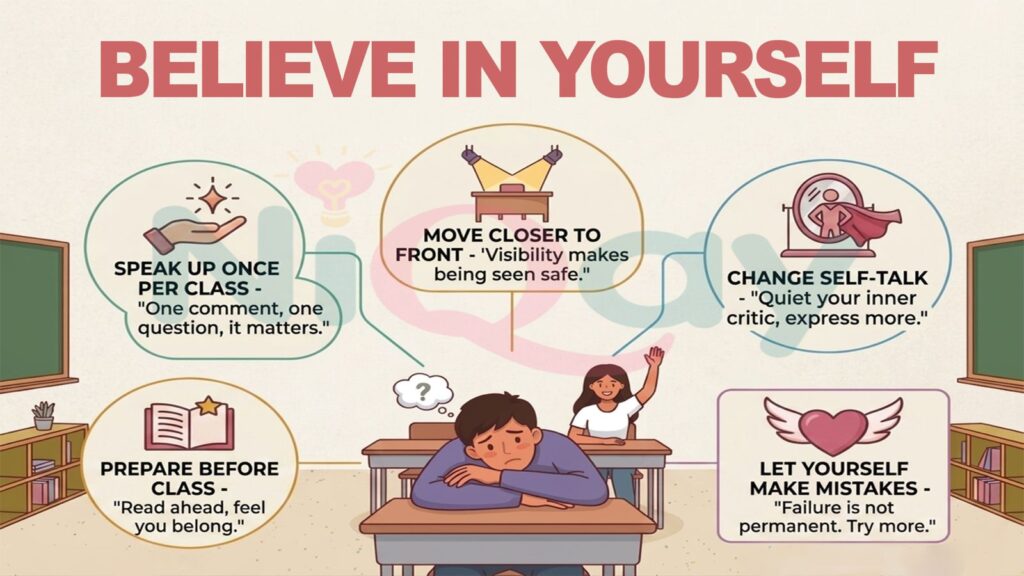
This is the smallest possible goal, which makes it work every time.
You don’t have to become confident overnight.
You just have to speak once. One comment. One question. One observation and thats it.
“I used to tell myself I’d speak up when I was sure, when I had the perfect thing to say. I never did. Once I gave myself permission to just say something and anything, once I did it gave me freedom and a feeling that my thoughts matter too.
So, every time you put yourself out and survive, your brain will file it as an evidence that it’s safe to try again.
2. Move closer to the front seats
The last seats are a hiding place, and they can overshadow your personality.
It feels safe back there because nobody calls on you, nobody looks at you, and you can drift through the lesson without being seen.
But that’s exactly what we have to conquer.
The more you disappear, the harder it becomes to stop feeling invisible in school.
The students who sit in front are not always the smartest ones, They’re just the most visible.
And visibility, over time, quietly teaches you that being seen isn’t actually dangerous.
3. Prepare a little before class starts
Being afraid to answer questions in class is common and even the most confident student has to go through it, And the best cure for that fear isn’t bravery, it’s preparation.
When you’ve read ahead even a little, the terror of being wrong drops off.
You’re not going in blind anymore. You walk in with something in your pocket, a fact, a question, an idea. That small thing is enough to make you feel like you belong in your classroom.
4. Stop comparing yourself with others
You dot have to compare yourself to others, your fears, your insecurities, or your personality, because you are you.
Comparing is never a fair fight.
It’s one of the biggest reasons students lose confidence without understanding why.
“She always looks so sure of herself,” you think. What you don’t see is that she rehearsed her answer twice before raising her hand.
5. Change how you talk to yourself
Most students who struggle with self-doubt have a very loud inner critic.
It comments on everything and mostly negative .
“That was stupid.” “Don’t bother, you’ll just get it wrong.” “Nobody wants to hear what you think.”
That voice feels true. But it isn’t. It’s a habit that needs to be changed.
Research in educational psychology links this directly to self-efficacy: a student’s belief in their own ability to handle challenges.
When that belief is low, students stop trying. When it grows, even a little, behaviour starts to change.
They express more. They try more. They grow more.
6. Use your body to calm your brain
Your body and your brain are in constant conversation, so when your body is calm your brain is calm too.
When you slump into your chair and cross your arms, your nervous system reads that as danger.
When you sit up, breathe slowly, and keep your shoulders back, your brain gets a very different message about safety and belongingness.
A few slow breaths before you speak can genuinely lower the physical symptoms of anxiety
7. Let yourself Make Mistakes
Confident students are also wrong sometimes but they just agree upon being wrong out loud.
They just don’t treat a wrong answer as proof of something permanent about themselves.
Overcoming fear of failure isn’t about never failing, it’s about deciding that failure doesn’t get the final word.
8. Ask questions instead of giving answers
If raising your hand to answer still feels too exposed, start by asking instead.
A genuine question is just as valuable as an answer.
And for students working on how to be confident in class, it’s a lower-risk starting point because you can’t be “wrong” for being curious.
9. Find one person who makes you feel safe
Social confidence for students rarely grows in isolation.
It usually grows in the presence of at least one person who makes you feel like your voice matters.
That person might be a classmate, a teacher, a friend in a different subject, it doesn’t matter.
What matters is finding them.
10. Join something outside the classroom
The classroom can feel high-pressure because there are grades attached.
Everything feels like it counts.
But clubs, teams, and extracurriculars operate differently, and for introverted students building confidence, these spaces are often where the real growth quietly begins.
11. Stop waiting to feel ready
This might be the most important thing on this entire list.
Confidence does not arrive before the moment.
It arrives because of the moment.
That’s how academic confidence actually works not through preparation alone, but through action taken before you feel ready for it.
12. Notice what you’re actually good at
When self-esteem is low, the brain filters out evidence of your strengths and amplifies every flaw. It’s not lying exactly, but it’s not giving you the full picture either.
You have to actively look for the parts it keeps skipping over.
Maybe you explain things clearly to friends.
Maybe you ask unusually thoughtful questions.
Maybe you work harder than people realise, or notice details others miss.
These things are real. They count. They deserve to be on the list your brain keeps about you.
Building confidence as a student isn’t about delusion. It’s about holding an honest, complete view of yourself, strengths included.
13. Celebrate the small wins
Students who are working on how to overcome self-doubt often make real progress, and then dismiss it.
You answered a question today? “It was easy anyway.”
You introduced yourself to someone new? “That doesn’t really count.”
This habit of minimising your wins keeps your confidence stuck at zero no matter how much you grow.
A win is a win.
14. Stop needing everyone to approve of what you say
A lot of what makes students shy in class comes down to this: you want to talk, but you need everyone to think it is good.
That’s an impossible standard.
Even the most confident speakers say things that land flat sometimes.
The difference is they don’t need the room’s approval to feel okay about themselves afterward.
15. Remember why you’re actually there
This sounds obvious.
But it’s easy to forget when you’re focused on not being embarrassed. You’re not in that classroom to survive without being noticed.
You’re there to learn, and learning is a deeply active thing.
It asks you to show up, make mistakes, ask questions, and engage. A growth mindset isn’t a poster on the wall.
It’s a decision you make every time you choose to participate instead of hide.
The Last line
Confidence isn’t a switch you flip. It’s a muscle, built slowly, through repetition, through small acts of bravery that nobody else might even notice.
But you’ll notice.
And over time, those moments will add up into something that genuinely feels like the student you’ve always wanted to be.
Pick one thing from this list. Just one. Start tomorrow.
The quiet student in the back row has always had something worth saying. It’s time to say it.
At Niqay, we understand what students go through, because not too long ago, we were students too.
The confusion, the pressure, the fear of making the wrong choice, we’ve been there. That’s why we’re building more than just a community.
We’re creating a space where you feel supported, stay safe, grow with confidence, and overcome every fear and insecurity together.
You don’t have to figure it all out alone.
Join our community and grow with people who truly get it.