

You can ace every test and still fall apart the moment things get hard.
That sounds harsh, right? but it is true for a lot of students.
Grades measure how much you know.
They do not measure how well you handle stress, how you treat people around you, or what you do when everything goes sideways.
That is where emotional intelligence comes in.
And once you understand what it actually is, you will see why it matters more than most things you are learning in school right now.
What emotional intelligence actually means
Emotional intelligence is your ability to understand your own feelings and the feelings of people around you.
It is also about being able to manage those feelings in a way that helps you rather than hurts you.
Think of it this way.
Imagine you failed a test you studied hard for.
One student shuts down, stops trying, and tells themselves they are just bad at the subject.
Another student feels frustrated for a bit, figures out what went wrong, and tries a different approach next time.
Same situation. Very different outcomes. That difference is emotional intelligence at work.
The term was made popular by psychologist Daniel Goleman in the 1990s.
He argued that how you handle emotions often matters more than raw intelligence when it comes to long term success.
Decades of research since then have backed him up.
The 5 pillars of EQ every student should know
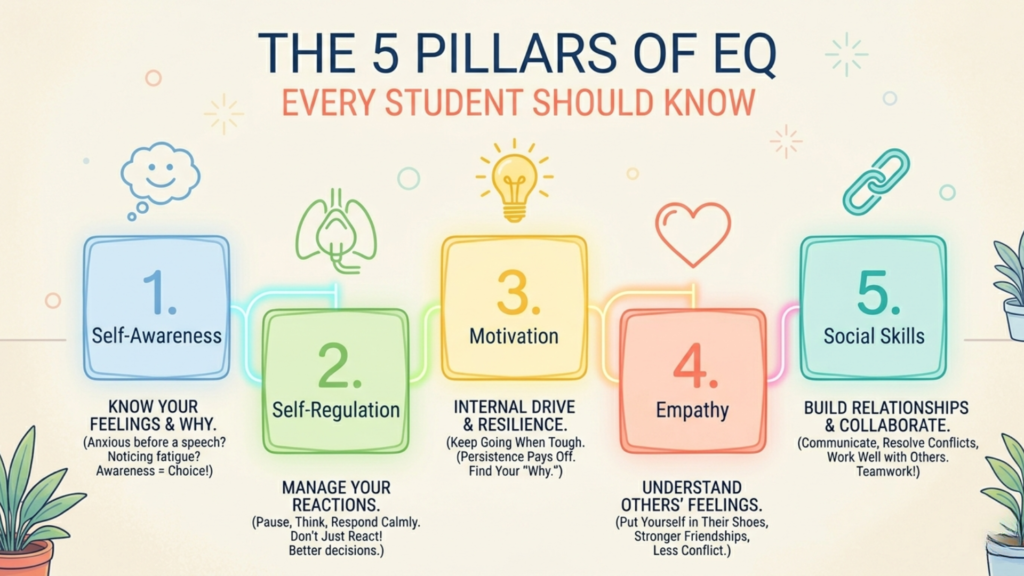
Emotional intelligence is not one single thing.
It is made up of five parts that all work together. Each one plays a role in how you show up at school, at home, and in the world.
Here is a breakdown of all five and what they actually look like in everyday student life.
1. Self-awareness
This is knowing what you are feeling and why.
It sounds simple but most people skip right past their emotions without ever naming them.
A self-aware student knows when they are anxious before a presentation.
They notice when they are irritable because they did not sleep.
That awareness gives them a choice about what to do next.
2. Self-regulation
This is what you do after you notice the feeling.
Self-regulation means you do not just react.
You pause, think, and then respond in a way that others would like.
3. Motivation
EQ motivation is not just about wanting good grades.
It is about having an internal drive that keeps you going even when things are not going well.
Students with strong motivation do not need someone standing over them to get things done.
They find reasons to keep going.
4. Empathy
Empathy is the ability to understand how someone else is feeling. Not just feeling sorry for them.
Actually putting yourself in their position and getting it.
This makes a huge difference in friendships, group projects, and how you handle conflict.
Empathetic students tend to have better relationships and way fewer unnecessary fights.
5. Social skills
This is how you use all the other pillars when you are actually around people.
It includes how you communicate, how you handle disagreements, and how well you work with others.
Strong social skills do not mean being the most popular person in the room.
They mean being someone people trust and want to work with.
How EQ affects academic performance
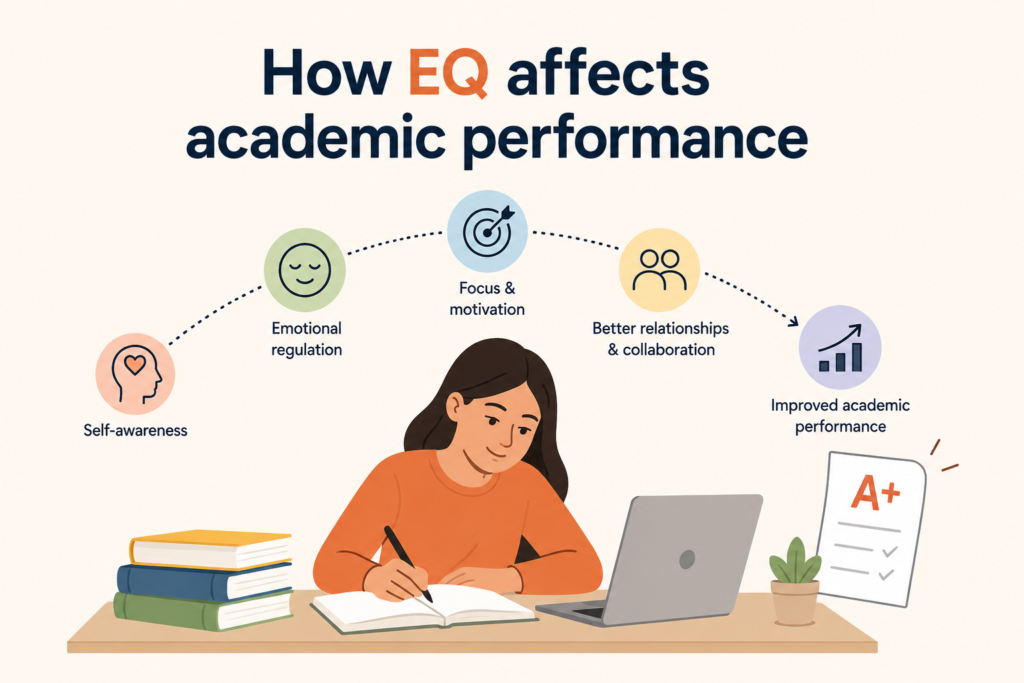
There is a lot of research connecting emotional intelligence to how well students do in school. And the results are pretty consistent.
Students with higher EQ tend to have better focus, handle exam stress more effectively, and recover faster when they get a bad grade.
They are also less likely to give up when things get hard.
A study published in the journal Frontiers in Psychology found that EQ was a strong predictor of academic performance, even after controlling for IQ.
Another review found that students with strong emotional skills had better relationships with teachers, which directly affected how much support they got in class.
And to be honest, It makes sense when you think about it.
If you can manage stress, you study better.
If you can communicate well, you get more help.
If you understand your emotions, you make better decisions about how to spend your time.
EQ vs IQ: why the smartest students sometimes struggle
Being intellectually gifted does not protect you from struggling socially, emotionally, or even academically in the long run.
The table below breaks down the key differences between the two.
| IQ | EQ | |
| What it measures | Logic, reasoning, knowledge | Emotions, relationships, self-awareness |
| Can it change? | Mostly fixed after childhood | Can grow throughout your life |
| How it helps at school | Helps with tests and problem solving | Helps with stress, focus, and teamwork |
| How it helps in life | Gets you in the door | Keeps you in the room |
| What happens without it | You can be smart but hard to work with | You may struggle with direction and drive |
The students who burn out, freeze up under pressure, or fall apart in group settings are often the ones who have high IQ but low EQ.
They have never been taught to manage what they feel.
And on the flip side, students who might not be the top of the class academically often go on to do incredibly well in careers and life because they know how to work with people, handle setbacks, and stay motivated.
How to build emotional intelligence through everyday situations
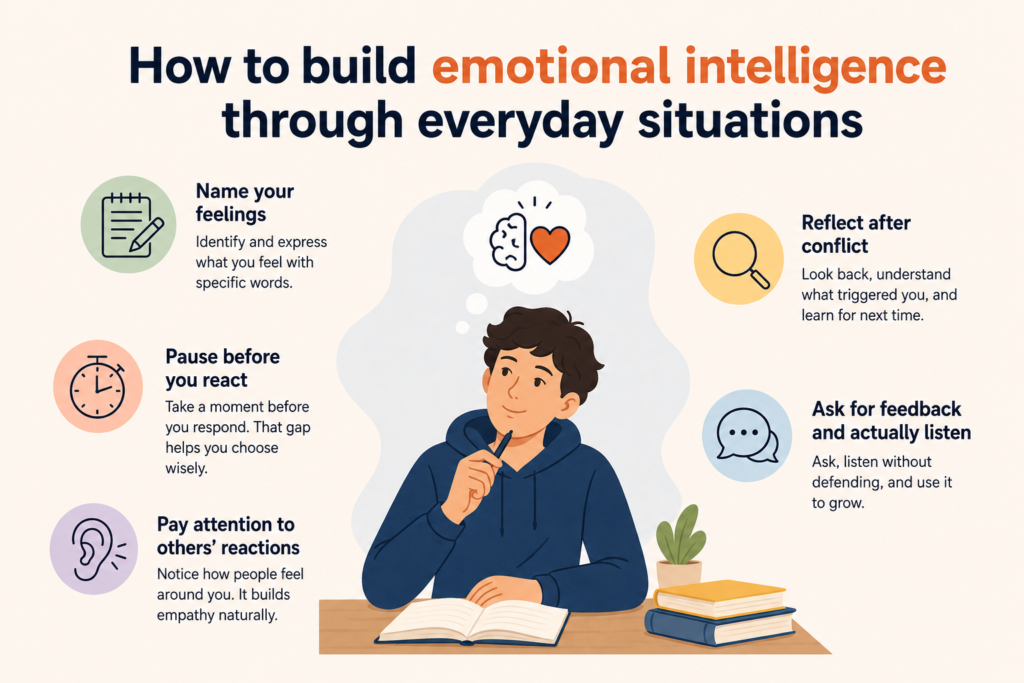
EQ is not something you are born with or without. It is a skill. And like any skill, it gets better the more you practice it.
You do not need a therapist or a special program to start.
Everyday life is full of moments to build it if you know what to look for.
Here are some real ways to actually develop EQ as a student.
Name your feelings out loud or on paper.
When something happens and you feel off, try to put a word to it.
Not just ‘bad’ or ‘stressed’ but something more specific like embarrassed, disappointed, or left out.
The more precise you get, the easier it is to deal with it.
Pause before you react: This one is hard but worth it. When something makes you want to react fast, like an unfair comment or a bad grade, give yourself two minutes before you say or do anything.
That gap is where emotional intelligence lives.
Pay attention to other people’s reactions: Start noticing when someone around you seems off.
You do not have to fix it. Just notice it. Over time, this builds empathy without you having to do anything dramatic.
Reflect after conflict: After an argument or a rough situation, ask yourself
what triggered you and whether your response helped or made things worse. No judgment, just honest reflection.
Ask for feedback and actually listen: This is one of the fastest ways to grow. Find someone you trust and ask them how you come across in certain situations. Then listen without defending yourself.
None of this is complicated: It just takes practice and a willingness to pay attention to yourself and the people around you.
The Last Line
Grades will open doors for you.
Emotional intelligence is what helps you walk through them and actually thrive on the other side.
Start small but Start now, because the version of you that handles your life is known as EQ!
EQ grows with practice, but it grows a lot faster when you’re around people who are actually working on the same things.
That’s exactly what Niqay is built for.
A space where you feel supported, grow with real confidence, and find friendships that are genuine, people who show up, people who aren’t performing, friends who are friends for real.
Because figuring out how to handle your emotions is hard enough without doing it alone.
Join the Niqay community and find people who actually get it.