
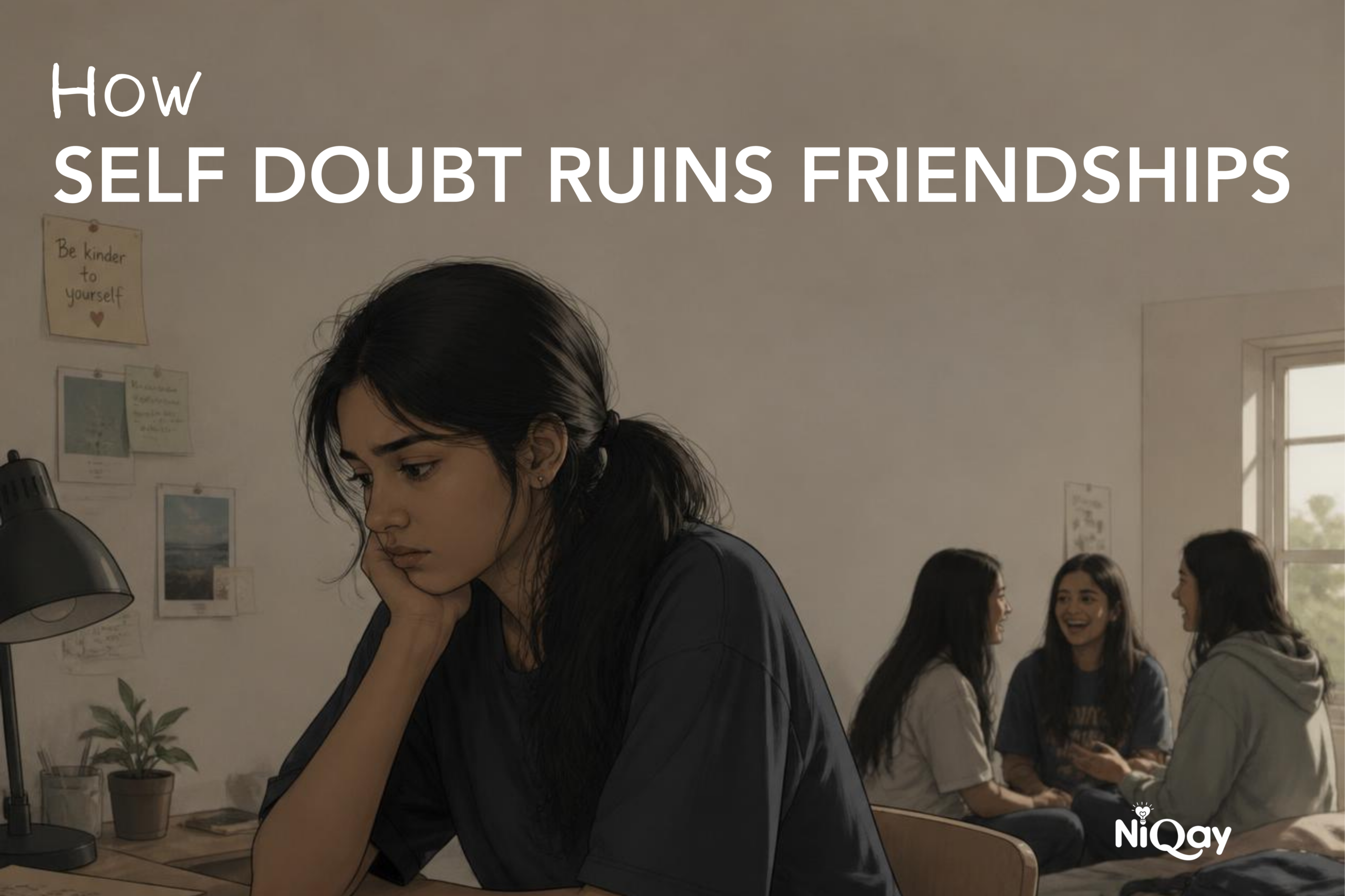
You come home after hanging out with friends.
It went fine. Nobody fought. But now you’re lying in bed replaying every single thing you said.
Was that joke too weird? Did I talk too much? Why did they go quiet after I said that?
Nothing bad happened. Your brain just won’t drop it.
That is what self-doubt in friendships looks like. Not dramatic. Not obvious. Just a quiet loop that runs on its own.
What Does Self-Doubt in Friendships Actually Look Like?
It is not the same as being shy.
Shyness is situational. It fades once you feel comfortable. Self-doubt is different. It follows you into rooms full of people you have known for years.
It tells you they don’t really like you even when nothing suggests that.
The tricky part is how quietly it changes your behavior. You start editing yourself before you speak. You hold back opinions.
You laugh at things you don’t find funny just to keep the vibe easy. Over time you become a safer, smaller version of yourself.
Low self-esteem and friendships are deeply connected.
When you don’t feel good about who you are, every social moment starts to feel like a test you might fail.
How Friendship Anxiety Changes the Way You Act Around People
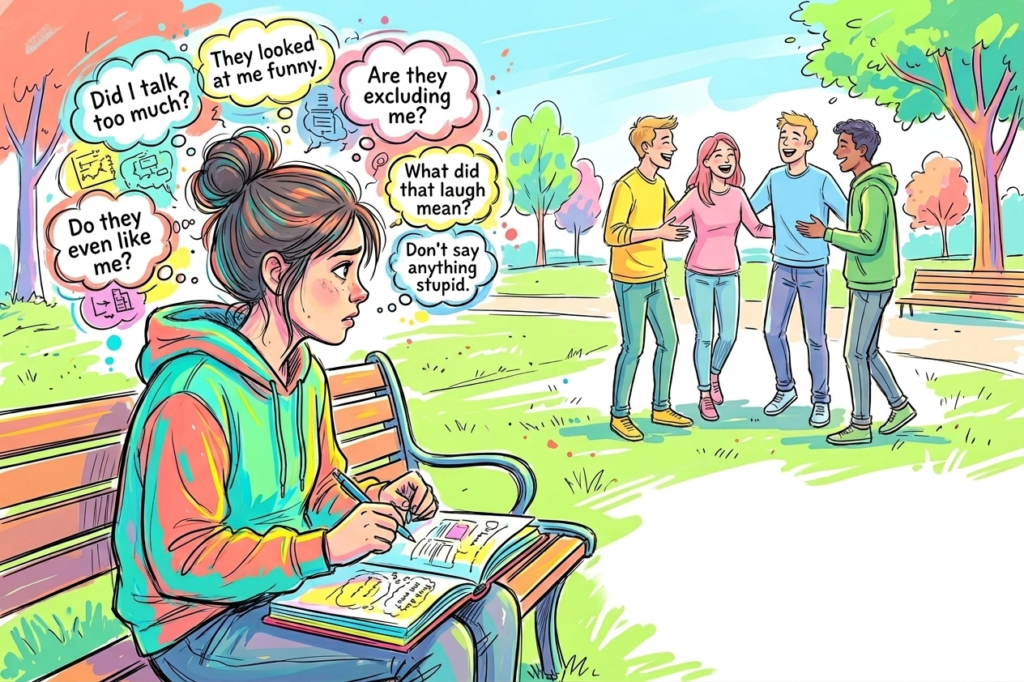
Social insecurity doesn’t just stay in your head. It shows up in how you move through friendships.
You stop initiating plans because rejection feels too risky.
You agree with people more than you actually agree.
You become hard to read because you’re guarding yourself constantly. People might even start seeing you as distant or unbothered when really you’re the opposite.
Fear of judgment is exhausting to carry.
You’re not just living the moment. You’re watching yourself live it and grading yourself at the same time.
That is why socializing sometimes feels more draining than staying home ever does.
Signs You Have Low Self-Esteem in Friendships
These are the signs that show that you have low self esteem in friendships:
- You replay every conversation in your head.
Something totally normal was said. Nobody reacted badly. But your brain keeps returning to it, picking it apart, wondering if it landed wrong.
This is overthinking friendships, and it is more common than people admit.
- You feel invisible in your friend group.
You are right there. You even tried to say something. But the conversation moved on without you. No one was rude but It just felt like another background noise.
That is one of the quietest and most painful sides of feeling insecure around friends.
- You are scared of being too much.
Am I texting too much? Did I overshare? Are they tired of me?
So you pull back.
You give people a watered-down version of yourself and then wonder why nothing ever feels genuinely close.
- You feel emotionally drained after socialising.
Here is what actually happens. When you have friendship anxiety, hanging out is double the work. You are talking and auditing yourself simultaneously.
Checking your tone, tracking reactions, managing how you come across. That kind of internal monitoring creates real exhaustion.
It is not a character flaw. It is what chronic self-doubt does to the body.
Why You Feel Lonely Even When You Have Friends

This is the part most articles don’t touch.
You can be surrounded by people who genuinely care about you and still feel completely unseen.
It happens when you are constantly performing a safer version of yourself instead of actually showing up.
The connection people feel is with the version you put forward.
Deep down you know that. So when a friend says they love spending time with you, something inside quietly thinks, “You’d feel differently if you knew the real me.”
That is the cycle between loneliness, trust, and self-doubt. Self-doubt makes you hide. Hiding makes real connection impossible.
The absence of real connection deepens the loneliness. And loneliness feeds the self-doubt right back.
A Quick Resource Before We Go Further
If you are a student navigating this, the work starts with building confidence from the inside out.
Read: 15 Practical Ways to Build Confidence as a Student
Actual steps. Built for real student life.
How to Stop Overthinking Friendships
- Move your attention outward.
Most people with social insecurity spend conversations watching themselves from the outside. Monitoring tone. Managing impressions.
The fix is simple but takes practice. Focus on the other person. What are they saying? What do they actually need from this conversation?
The more genuinely curious you are about them, the less room there is for self-monitoring.
- Make one small honest move per day.
Not a big vulnerability moment. Just something real. A genuine opinion. A joke you are not sure will land. A small disagreement.
These moments teach your nervous system that being authentic is survivable. Confidence gets built through repetition, not inspiration.
- Cut the reassurance loop.
Checking if someone is mad at you feels like it helps. It doesn’t. The relief is temporary.
The doubt always comes back asking for more. Instead, start asking yourself what you actually think about how something went.
Your own judgment matters. Practise trusting it.
How to Become Socially Confident Step by Step
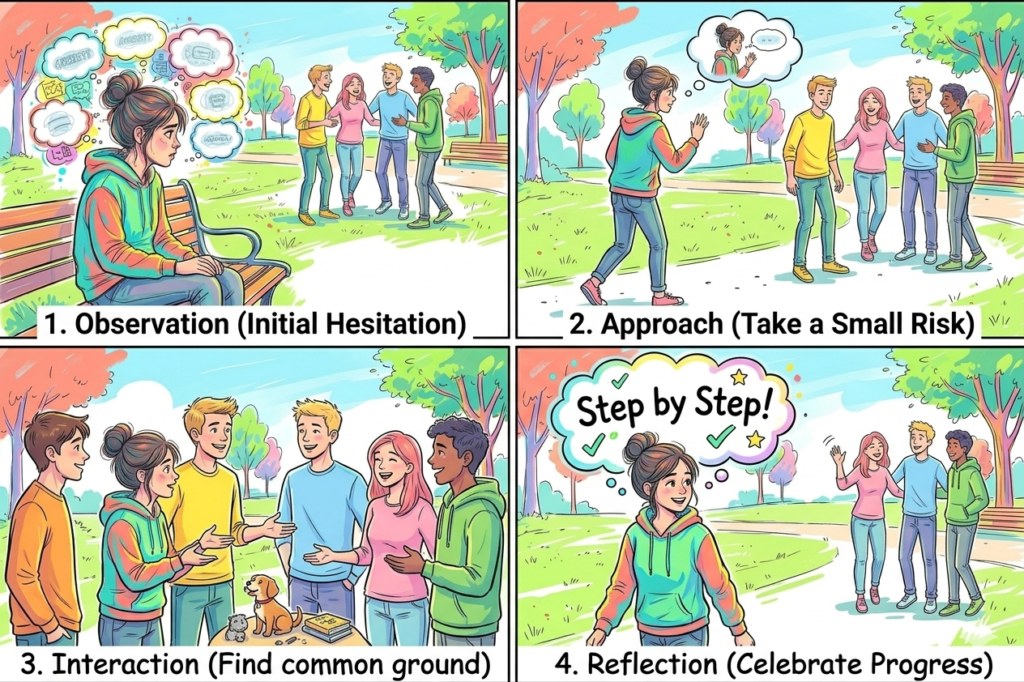
Real social confidence is not being loud or charming or never nervous. It is feeling settled enough in yourself that you stop needing every room to confirm you belong.
That starts with one friendship.
Pick someone who already feels safe. Let one true thing out in your next conversation. Not deep necessarily. Just real. Watch how they respond.
Good people meet honesty with warmth.
That warmth is the thing that slowly rewires how you see yourself in relationships.
Repeat it. Widen the circle slowly. Confidence in social situations is not a switch. It is a direction you keep walking in.
Self-Doubt Does Not Define Your Friendships
The people who like you already like you.
They are not sitting at home hoping you mess up. The conversation you have been replaying for three hours? They forgot about it before they got home.
Why self-doubt ruins friendships is not because it drives good people away. It is because it stops you from ever letting them fully in. You keep waiting until you feel ready. Until you feel worthy enough. That moment never comes on its own.
You do not need to fix yourself first. You just need to stop treating your spot in the friendship like something you have to keep earning.
The Last Line
At Niqay, we understand what students go through because not too long ago, we were students too.
The confusion, the pressure, the fear of making the wrong choice. The friendships that looked fine from the outside but felt hollow on the inside. We have been there.
That is why we are building more than just a community.
We are creating a space where you feel supported, grow with real confidence, and find friendships that are actually genuine. People who show up. People who are not performing either. Friends who are friends for real.
You do not have to figure this out alone.
Join the Niqay community and find people who actually get it.