

Maya walked up to the front of her 7th-grade class.
She had practiced her speech ten times the night before.
She knew every word.
But the moment she turned around and saw twenty-three faces staring at her, one thought hit her like a wall: What if I say something wrong and everyone laughs?
Her mind went blank. Her hands shook. Her voice came out small and wobbly.
She stared at the floor and rushed through the whole thing in under a minute.
Public speaking makes a lot of kids feel exactly this way.
The shaky voice, the racing heart, the sudden urge to disappear.
These are all real But also fixable. Not by pretending the nerves do not exist, but by learning how to work with them.
Understand Why It Happens
Before you can fix the problem, you need to understand it.
The fear of public speaking almost always comes down to two things: fear of judgment and fear of being laughed at.
What if I forget a word? What if I say something stupid? What if everyone stares at me like I got it wrong?
When the brain senses social threat, it reacts the same way it does to physical danger.
Heart rate goes up. Palms sweat. Voice tightens. The body is trying to protect you from embarrassment the same way it would protect them from actual danger.
This is not a weakness. It is biology. And once you understand why your body reacts this way, the reaction starts to feel less terrifying and more manageable.
Teach Them to Reset Before They Speak
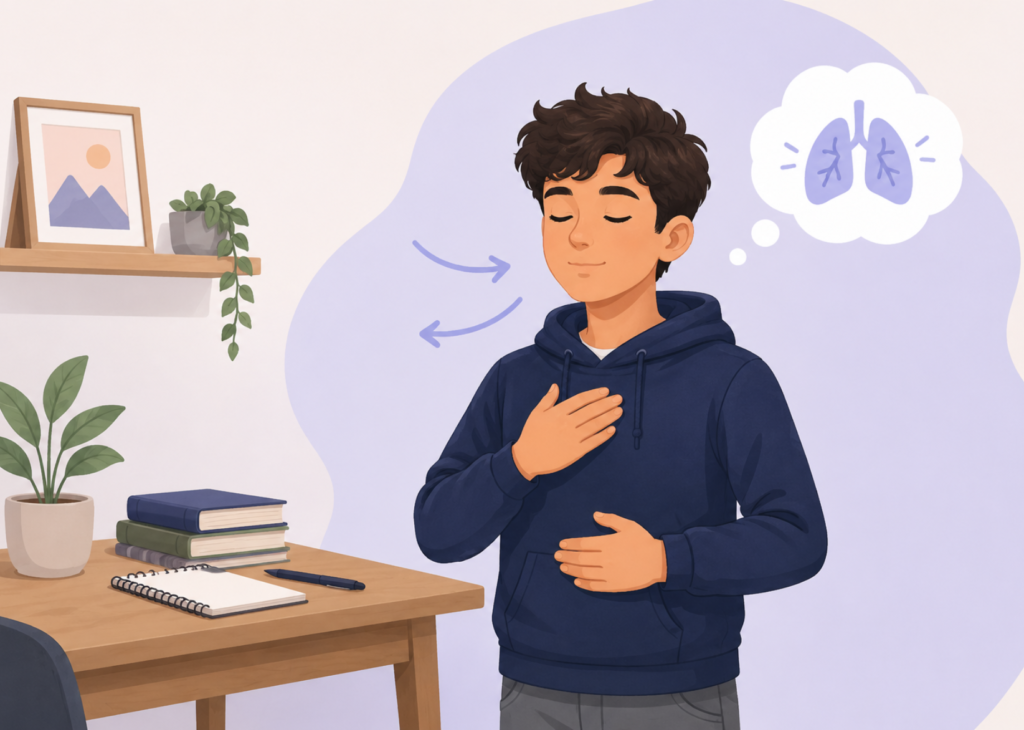
Once you understand what is happening in your body, you can learn to interrupt it.
The simplest tool is breath. Teach yourself to take two slow, deep breaths before saying a single word.
This immediately signals the nervous system to settle.
It gives you a moment to look up, feel their feet on the ground, and begin from a place of control rather than panic.
This sounds too simple to work. It is not. Practice it at home before anything that triggers nerves.
It becomes a habit fast, and habits hold even when nerves spike.
Build Confidence Through Preparation
A calm body is not enough on its own. You need to feel ready.
Confidence in public speaking does not come from natural boldness. It comes from preparation, and specifically from practicing out loud.
Saying words in your head and saying them out loud are completely different experiences. You should practice your speech to a wall, a mirror, a pet, a parent. Anyone.
Recording on a phone feels uncomfortable but it is also one of the most useful tools available.
You chil will hear exactly where you rush, where you mumble, and where you actually sound clear and strong.
A 2019 study published in the Journal of Anxiety Disorders found that students who reframed anxiety as excitement, telling themselves “I am excited” instead of “I am nervous,” performed significantly better. Their voices were steadier, their delivery more fluent, and they felt more in control. The words you say to yourself before they speak directly affect how they perform.
During the Speech, Focus on These Three Things
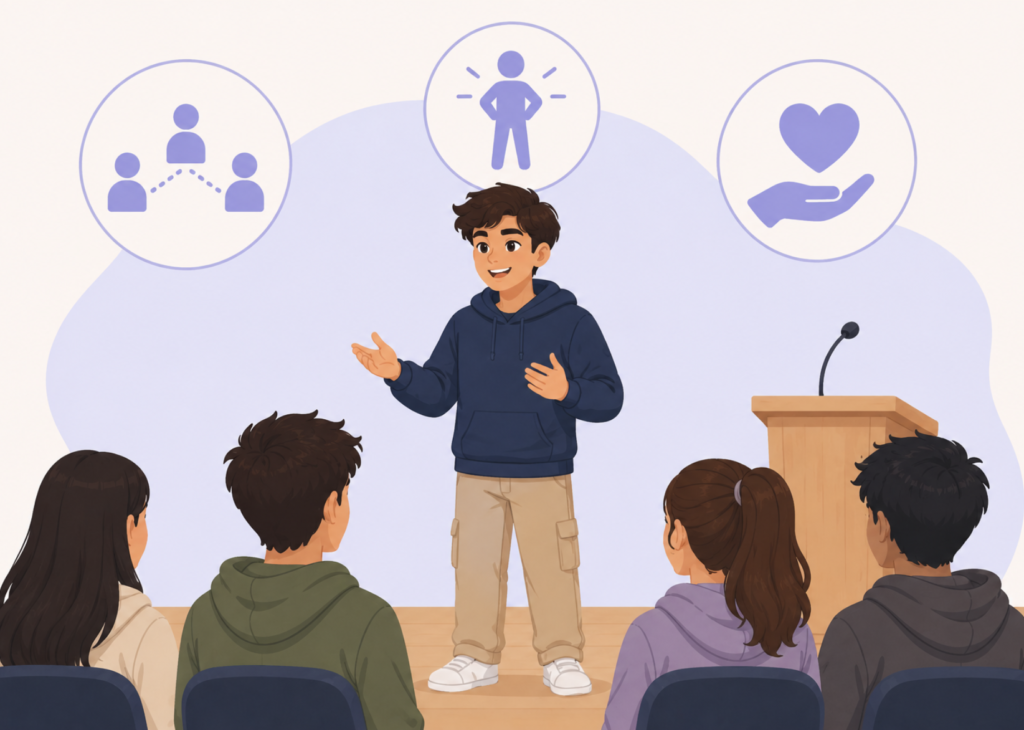
Once you are in front of the room, keep it simple.
Three things to focus on:
- Eye contact. Holding eye contact with a full classroom feels impossible. So teach yourself to pick three friendly faces in the room, one on the left, one in the center, one on the right, and rotate between them.From the audience, this looks like full room engagement. From the speaker’s side, it feels completely doable.
- Body language. Feet shoulder-width apart, hands out of pockets, eyes up, voice aimed at the back of the room. Posture changes how you feel from the inside, not just how you look from the outside. Try it at home. Slouch and speak, then stand tall and speak.
- Message over performance. Most nervous teens think: what if I mess up and everyone laughs? Confident speakers think: I have something worth saying. When you shift focus from their performance to their message, the self-consciousness shrinks. Communication coach Jessica Chen put it plainly: “Students who look down are having a conversation with the floor. Students who look up are having a conversation with people.”
The Last Line
Every confident speaker you have ever seen put in hours of uncomfortable, imperfect practice.
The shaky voice becomes steady. The blank mind becomes focused.
The kid who stared at the floor becomes the one who owns the room.
Public speaking for teens is a skill. Like every skill, it is teachable.
It builds with practice, with good feedback, and with someone helping you stack small wins into real, lasting confidence.
Help yourself build that skill the right way.
Niqay helps teen develop real communication confidence, not just for speeches, but for every classroom, conversation, and moment that asks them to speak up.
Enroll in our workshop to become confident speaker.