

something that nobody will ever tell you is that the fear isn’t about being wrong.
It’s about being watched while being wrong and that’s a completely different problem and so, it needs a completely different fix.
Most of the advices over internet sounds like “just raise your hand” or “practice more.”
But, That’s like telling someone with a broken leg to just walk faster and that is clearly not helpful.
This guide is different. Every tip here is a specific action you can try today. No fluff. No motivation quotes. Just real techniques that actually work.
Why Speaking in Class Feels So Scary (And It’s Not You)
Your brain is doing something called “spotlight effect.” You think everyone is watching and judging you.
But research shows people are barely paying attention to others. They’re thinking about themselves, just like you.
There’s also something called “evaluation apprehension.“
It’s the fear that others will judge your worth as a person, based on one answer. That fear is real. But it’s also scientifically proven to be wrong.
Studies from Cornell University show that people overestimate how much others notice their mistakes by almost 50%.
Half of the embarrassment you feel? Others don’t even register it.
Knowing this doesn’t stop the fear immediately. But it does give you a fact to hold onto when the fear starts talking.
Introverts vs. Shy People: Understanding the Difference
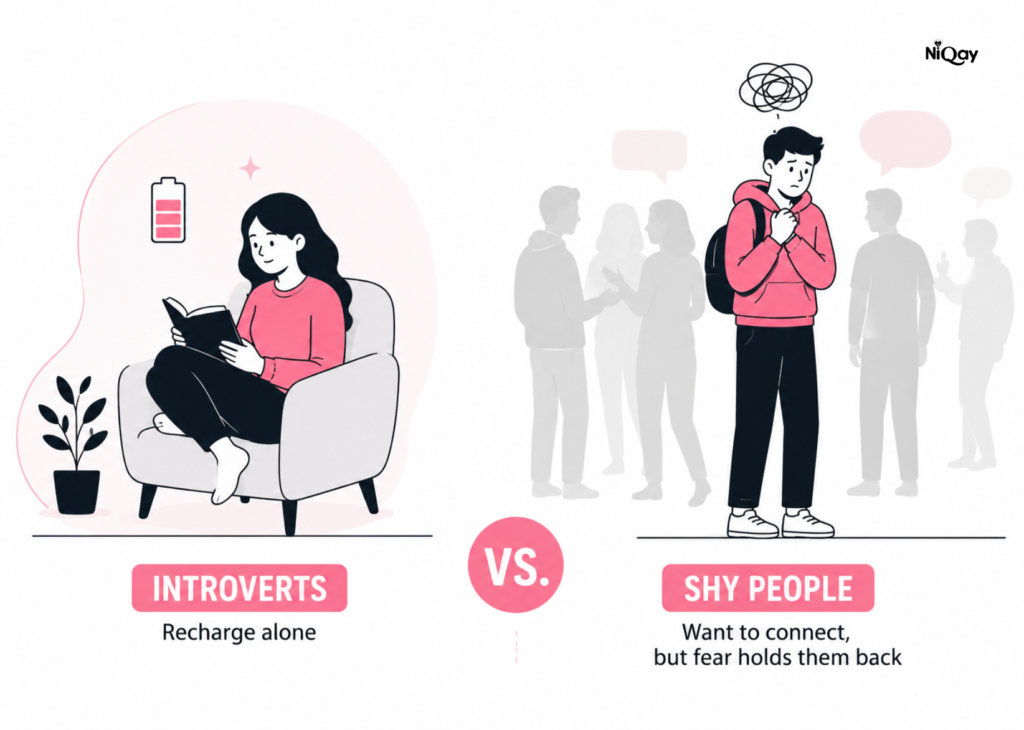
These two are not the same. Confusing them leads to wrong solutions.
Introversion is more about energy. Crowds and social situations drain introverts. They need alone time to recharge and It’s a personality trait, not a flaw.
Shyness on the other hand is about fear. Shy people want to connect but anxiety holds them back.
This is a learned behavior. And learned behaviors can be unlearned.
Many students are both. Some are introverted but not shy.
Susan Cain, author of the bestselling book Quiet, found that roughly one-third to one-half of all people lean introverted. You’re in massive company.
The strategies below work for both. But they’re designed especially for introverts who think deeply, and just need the right entry point into the conversation.
Micro-Steps to Start Participating in Class Today
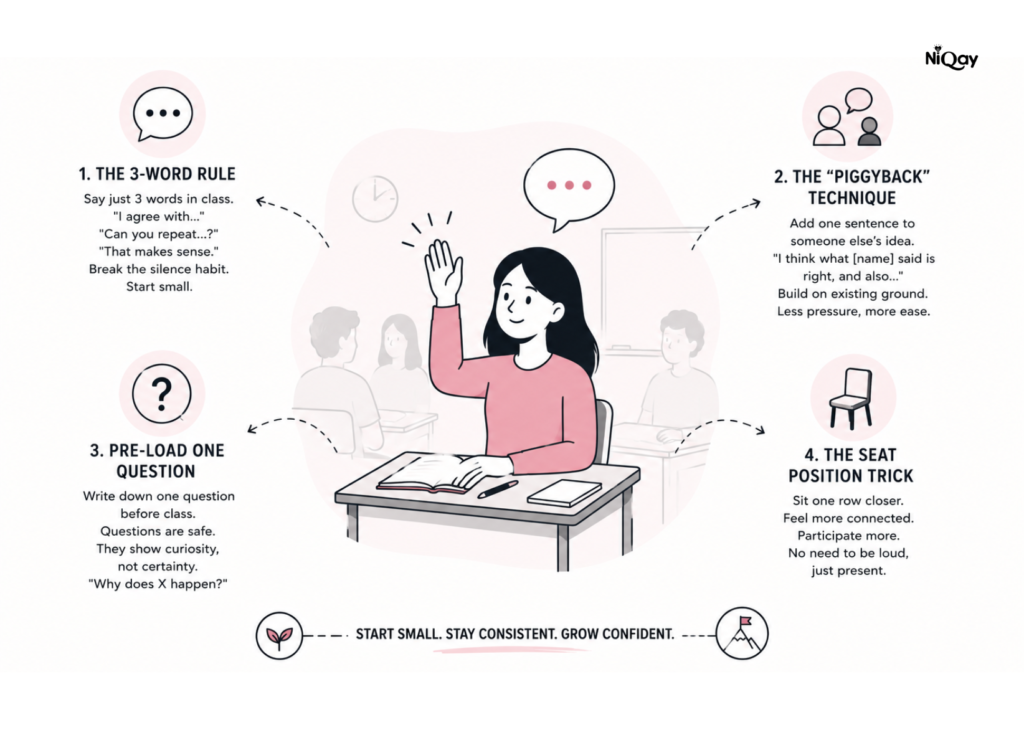
Don’t aim to make a speech. Aim to make a sound. Here are tiny actions that actually build classroom confidence over time.
The 3-Word Rule
Your only job today is to say 3 words in class. Not an answer. Not an opinion. Just 3 words.
“I agree with…” or “Can you repeat…” or “That makes sense.”.
The goal is to break the silence habit, not win a debate I mean that we will one day but as they say, start small to achieve big.
The “Piggyback” Technique
Wait for someone else to say something. Then add one sentence to it.
“I think what [name] said is right, and also…” This removes the pressure of starting fresh.
You’re building on existing ground. The class already has momentum, you’re just joining it.
Pre-Load One Question the Night Before
Before class, read your notes or the next topic for 10 minutes. Write down one question, just one.
Questions are safer to ask in class. They don’t require you to be right. They just require you to be curious.
“Why does X happen?” or “What’s the difference between A and B?”
The Seat Position Trick
Researchers found that students who sit in the front-center participate more, not because they’re confident, but because they feel more connected to the teacher.
Try sitting one row closer than usual. Just one row. It shifts your psychology without feeling dramatic.
Activity: The “Speak Once” Weekly Tracker
Take a small notebook. At the top, write the days of the week.
Each day, your only goal is to speak once in any class.
A question, a comment, even a partial answer.
Put a checkmark when you do it. After 3 weeks of this, most students report that speaking starts to feel automatic, not scary.
How to Express Your Ideas When You Think Better in Writing
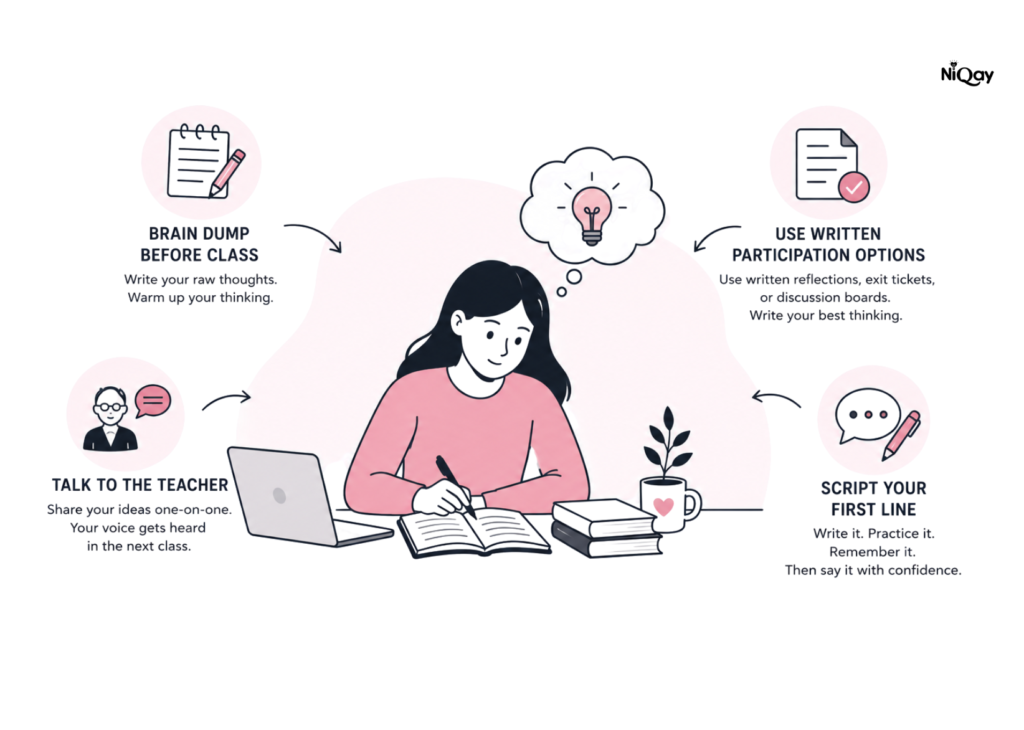
Introverts often process thoughts deeply, but slowly.
Speaking out loud in real time feels like being asked to type without a keyboard.
Here’s how to work with your brain, not against it.
Use the “Brain Dump Before Class” Method
Spend 5 minutes before each class writing your raw thoughts about the topic. Not clean notes. Just whatever you think.
This warms up your thinking.
When discussion starts, your brain already has material loaded, it just needs to be spoken, not created from scratch.
Talk to the Teacher Before or After Class
One-on-one is where introverts thrive. Share your thoughts with the teacher outside class hours.
Many teachers will reference your ideas in the next class, which means your voice gets heard even when you didn’t raise your hand.
This is not cheating the system. This is using the system intelligently.
Ask for Written Participation Options
More teachers now accept written participation, exit tickets, online discussion boards, written reflections.
If your school or teacher offers this, use it fully.
Some research shows written participation actually leads to deeper thinking than verbal responses. Use your strength.
Activity: The “Script Your First Line” Exercise
The hardest part of speaking is always the first line. So write it out the night before.
Literally write: “Tomorrow in history class, I will say: ‘I think the main reason for X was Y.'”
Practice saying it out loud twice before sleeping. This creates a memory trace.
When the moment comes, you’re not inventing, you’re remembering.
What to Do When Your Mind Goes Blank Mid-Answer
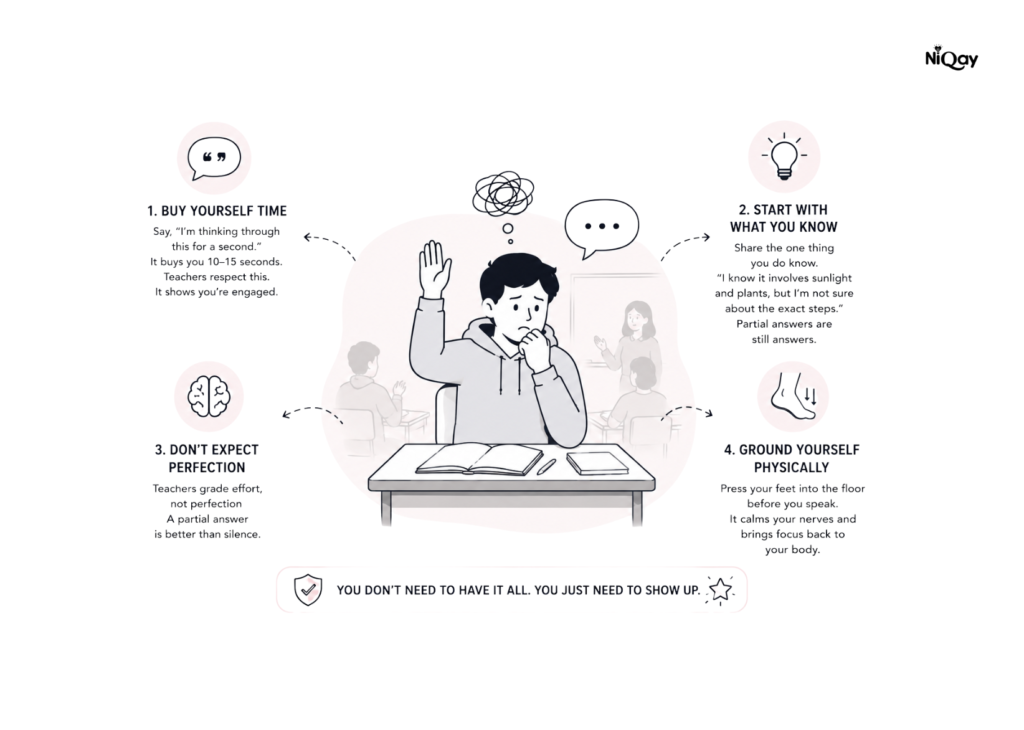
This is the moment every introverted student dreads. You raise your hand. The teacher calls on you. Your brain empties completely.
Here’s what to do. Say “I’m thinking through this for a second.” That’s it. Those 6 words buy you 10–15 seconds.
Teachers respect this. It signals you’re engaged and not clueless.
During those seconds, don’t try to remember everything. Just say the one thing you do know.
Also try this technique called “Start with what you know.” If asked about photosynthesis and you blank out, say:
“I know it involves sunlight and plants, but I’m not sure about the exact steps.” Partial answers are still answers.
Teachers grade effort, not perfection.
There’s also a physical trick. Before you speak, press your feet firmly into the floor.
This grounds your nervous system.
It takes your brain’s focus slightly away from the anxiety and back into your body.
It sounds weird but It works.
The Last Line
The Real Goal Isn’t to Speak More, It’s to Be Heard
Introverts don’t need to become loud. They need to become strategic.
The classroom rewards those who speak up , but it doesn’t require constant talking.
Even one well-placed comment per class can shift how a teacher sees you. One real question per week can shift how you see yourself.
Your ideas are worth hearing. The only job now is to find the smallest door to walk them through.
That’s exactly what Niqay is built for.
A space where you feel supported, grow with real confidence, and find friendships that are genuine, people who show up, people who aren’t performing, friends who are friends for real.
Because figuring out how to find your identity as a teenager is hard enough But you don’t have to do it alone, you can Join the Niqay community and find people who actually get it.