
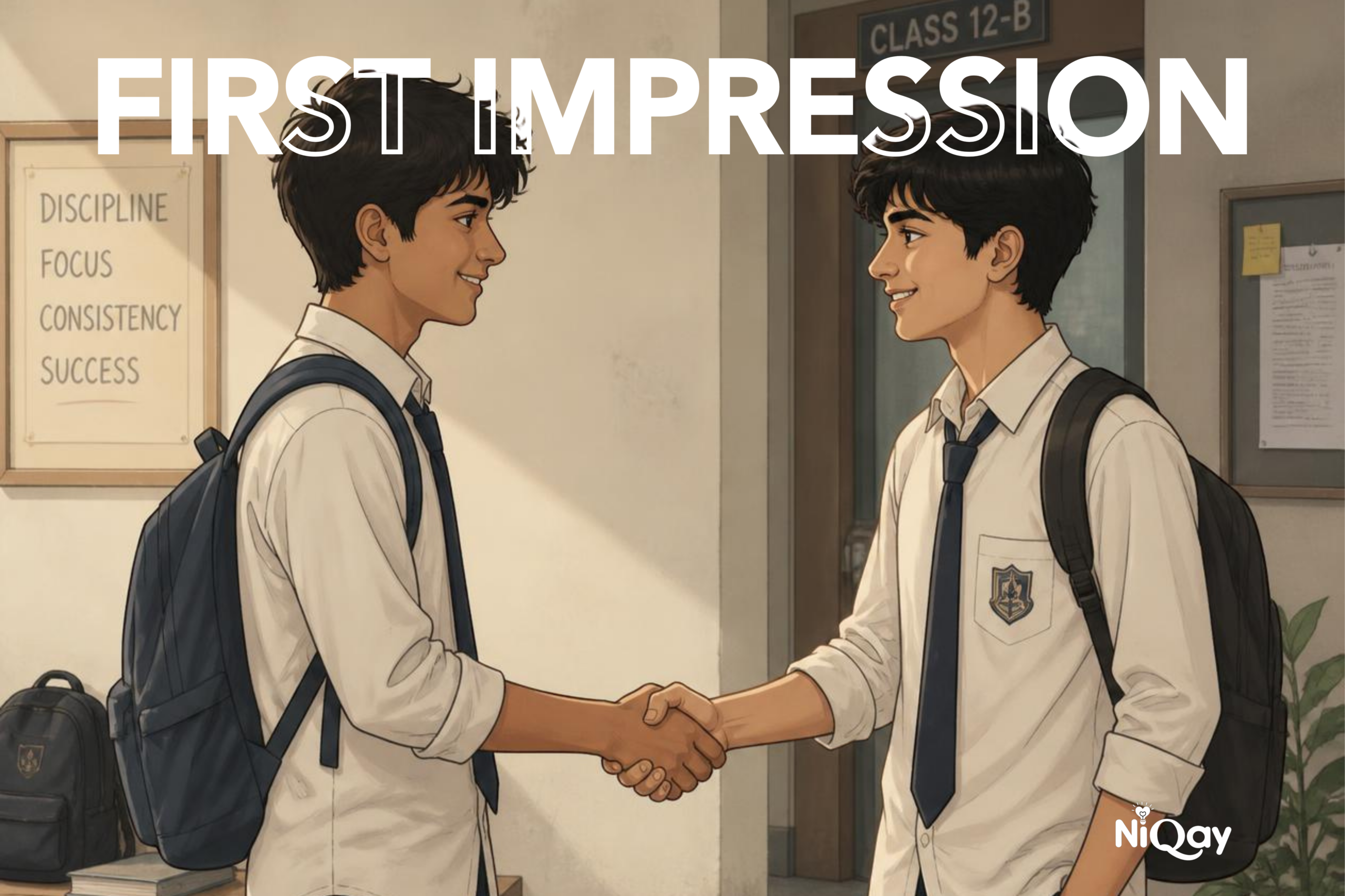
My name is Vidhi, I live in Delhi…
I cringe every time I think about it.
That was my introduction for so many years. And every time I said it, the room didn’t react badly. It just didn’t react at all. Which somehow felt worse.
Nobody ever told me that it was wrong and especially my school. In fact, my school taught me exactly that. Stand up, say your name, say where you live, sit down. Full marks. Moving on.
I genuinely thought that was it. Turns out, it isn’t.
What a Psychologist Found Out About Your First 7 Seconds
In 1993, psychologists Nalini Ambady and Robert Rosenthal ran a study called “thin-slicing.”
The idea was very simple, if people can make accurate judgments about someone based on just a tiny slice of their behaviour?
The answer was yes. Uncomfortably and quickly.
Research found that interviewers make their hiring decision within the first 7 to 30 seconds of meeting a candidate.
The rest of the interview? They spend it looking for reasons to confirm what they already decided.
Your child could give the most thoughtful, well-prepared answers for 45 minutes straight and it might not matter at all.
Because the interviewer already made up their mind in the time it takes to say “my name is, I live in, I study in.”
Psychologists call this the primacy effect. The first information we receive sticks. It colours everything that comes after.
A strong opening makes every answer sound smarter. A weak one makes even great answers feel like they’re fighting uphill.
So when your child opens with a name, a city, and a school, they’ve already handed that first impression away. To nothing.
What Schools Teach vs What the World Rewards

Schools teach your child to introduce themselves like a form. Name. Location. Institution. Done.
The world rewards something completely different.
Interviews, college admissions, that one conversation with someone who could change everything. It rewards a person who sounds like they know who they are.
Not someone who recites facts about themselves. Someone who makes you feel something in the first ten seconds.
Curiosity. Interest. The urge to keep listening.
Nobody in any classroom is teaching your child how to do that.
The Difference Isn’t Confidence. It’s awareness.
Two kids. Same age, same city, same school.
First one walks in. “Hi, I’m Aryan. I’m 16. I study in DPS Dwarka.”
Second one walks in. “I’m Aryan. I’ve spent the last year obsessing over why Indian cricket teams collapse in knockout matches and I’ve been building a data model to figure out if there’s actually a pattern.”
Same Aryan. Completely different rooms.
The second Aryan isn’t more confident.
He’s just more aware of what makes him interesting, of what makes a stranger lean in, of how to give someone a reason to remember him.
The Habit Forms Early and Stays Long

The scary part is that children practice the wrong version so many times that it becomes automatic.
By the time they’re standing in front of a college interviewer at 17, or a recruiter at 22, or someone important at a networking event at 25, it comes out the same way it always has.
Name. City. Institution. Pause.
And then they wonder why the room moved on.
First impressions compound.
The child who learns to introduce herself well at 13 walks into every room differently at 23.
Not because she’s more qualified. Because she’s been heard from the beginning.
So What Does a Good Introduction Actually Have?
It doesn’t start with a name. It starts with something that makes the other person think, wait, tell me more.
It’s specific. It has a point of view. It sounds like a person and not a walking linkedin profile.
It gives reality, a passion, a pursuit, a perspective, that only that child could say.
And it’s completely learnable. It just needs the right space. Not a classroom where the goal is to finish the exercise.
A real environment where someone helps your child figure out what their one real thing actually is and then helps them say it out loud until it feels like theirs.
The goal was never to sound impressive. It was always to sound like themselves.
That’s exactly what we work on at Niqay workshops. We help your child find their own introduction. The one that’s true, and memorable, and entirely theirs.
So they never have to start with “my name is” again.
Enroll your child in our workshop before the habit gets any older.