School gives you equations and deadlines. It rarely gives you a way to deal with what is happening inside your head.
That is where creative expression comes in. For teenagers, it is not just a hobby. It is one of the most useful tools you will ever have.
Research shows that teenagers who use creative outlets have lower stress hormones and better emotional control.
When you block expression, emotion does not go away. It builds.
What Is Creative Expression for Students?
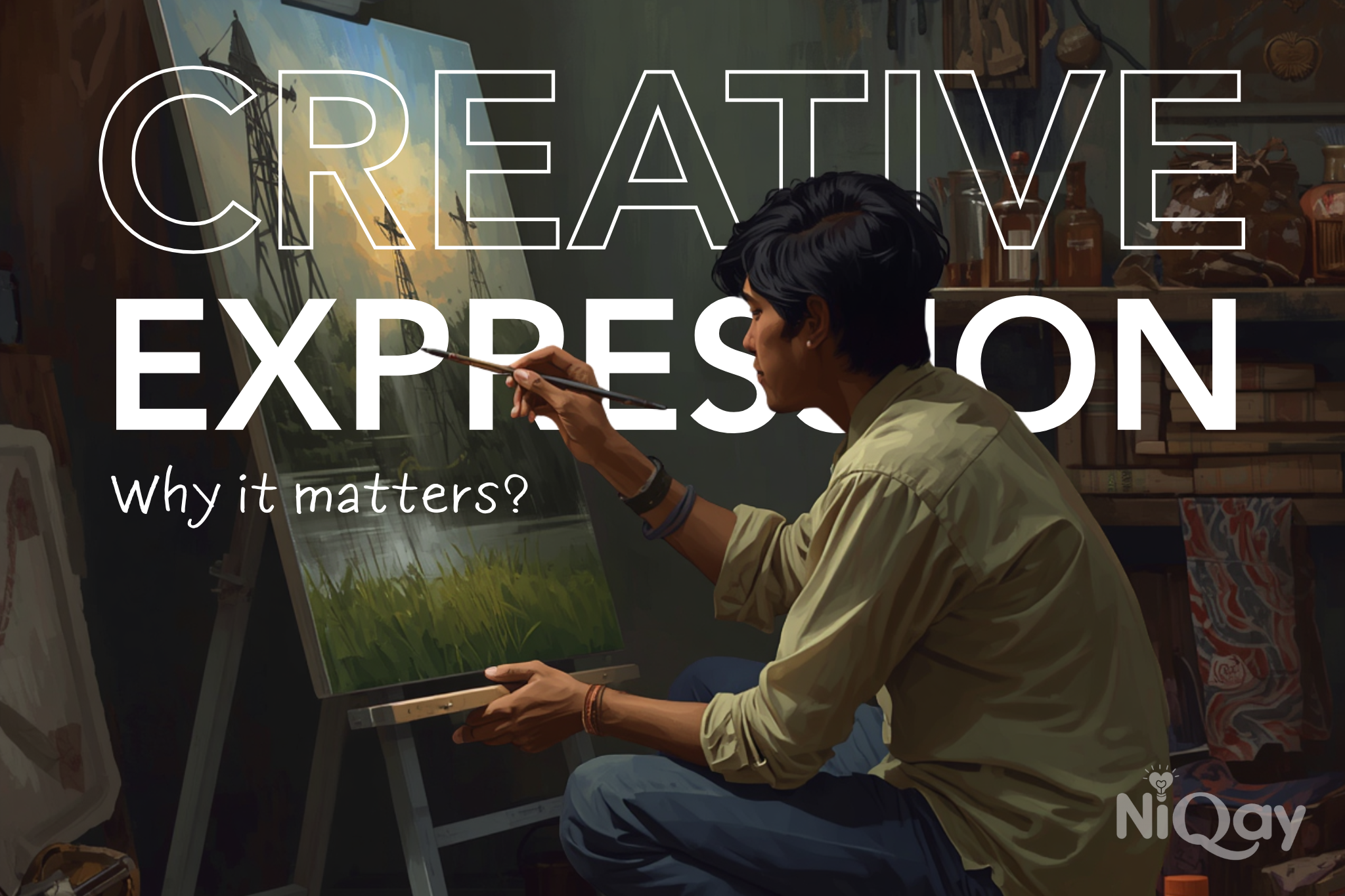
Creative expression is not about talent. It is the act of taking something internal, a feeling or a thought that will not leave you alone, and giving it a form outside your body.
That can be words in a journal, a sketch in a notebook, or a playlist built at 1 a.m.
Psychologists call this externalization. When something stays inside your head, your brain treats it as unresolved.
The moment it is outside, written, drawn, or played, your nervous system processes it differently.
It shifts from threat to record. You are not numbing the feeling. You are translating it.
Why Journaling, Art, and Music Help Students
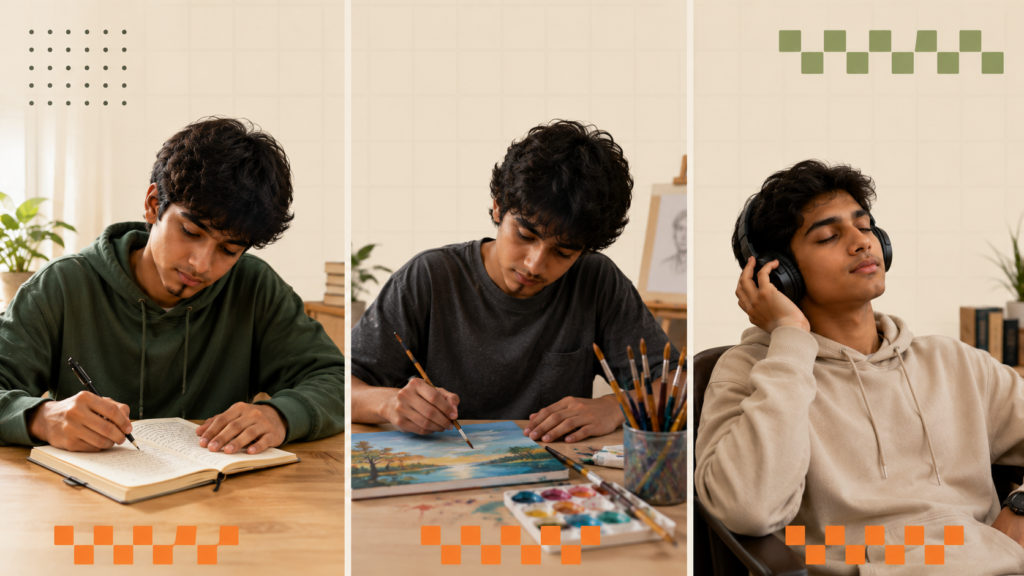
Most teenagers are never taught how to handle emotions. You are told to calm down but not shown how.
Creative expression fills that gap through practice, not rules.
Journaling activates the prefrontal cortex, which handles rational thought and emotional control.
Visual art works through non-verbal processing, the most accurate route for feelings like grief and confusion that resist language.
Music reaches the limbic system directly, bypassing conscious thought and connecting with emotional memory in ways that words cannot.
- Reduces stress and anxiety by giving emotion somewhere to go
- Improves emotional intelligence by building a habit of reflection
- Builds self-awareness and confidence through repetition
Students who keep any creative practice for months develop what researchers call affective tolerance, the ability to sit with hard feelings without being overwhelmed.
How Journaling Helps Students Think Clearly
There is a specific kind of mental fog most teenagers know well. Something is bothering you but you cannot name it, and because you cannot name it, you cannot deal with it.
Journaling breaks that loop. Writing converts vague emotional pressure into structured thought.
Dr. James Pennebaker at the University of Texas found that people who wrote about difficult experiences for just 15 minutes a day showed real improvements in sleep and mental wellbeing.
Writing forces your brain to stop holding the emotion in active memory.
- Organizes thoughts into words so they feel less chaotic
- Helps you reflect without judgment because no one else will read it
- Creates a sense of closure that reduces rumination
You do not need to write well. Grammar does not matter. What matters is honesty.
How Art and Music Help Students Express Emotions
Not every feeling fits into words. Art and music let you skip that requirement entirely. Expression comes first.
Understanding comes after.
A 2019 review in JAMA Pediatrics found that music-based practices for teenagers consistently reduced depression and anxiety across different populations. It did not require training. It required engagement.
Art holds contradiction in a way language cannot.
A drawing can be angry and sad at the same time, and the visual field does not ask it to be only one thing.
- Art captures emotions visually for experiences that resist language, like social pain and identity confusion
- Music connects with rhythm and mood and can shift your nervous system within minutes
- Both allow release without explanation, no justification needed for what you made or why
How to Build a Creative Habit as a Student

The biggest block is not time. It is the belief that what you make has to be good. The moment expression becomes performance, it stops working.
- Write for 5 minutes daily, not to say something meaningful, but to say something true
- Keep a sketchbook nearby, actually in reach, not stored away somewhere
- Listen to music intentionally at least once a day, not as background noise
Five minutes daily builds more habit than one hour on weekends. The brain learns through repetition, and the habit of returning to expression is what makes it stick.
The Last Line
The emotions you feel at 15 are not simpler versions of adult emotions. In many ways they are more intense.
The emotional centers of the brain are fully developed in adolescence, but the regulatory centers are not complete until your mid-twenties.
Students who express regularly learn something quietly important. Feelings are temporary. They are not emergencies.
They are not proof something is wrong with you. They are just information, and creative expression is how you learn to read it.
That skill does not stop mattering after school. It shapes every relationship, every hard decision, and every version of yourself that comes after.
Not everything you feel needs to stay inside.
At Niqay, we create spaces where students learn to express, not impress.
Explore workshops designed to help you turn thoughts into confidence visit niqay.in