Remember when a single assignment could make you go insane?
You’d sit in the front of your notebook with no idea of what the text says and so you’d text a friend, “wait did you get question 7,” and half the time neither of you did.
You’d get it wrong. You’d try again. It was annoying, honestly. But somewhere in that annoying process, you actually learned the thing.
But that learning process has changed, or has it been completely replaced.
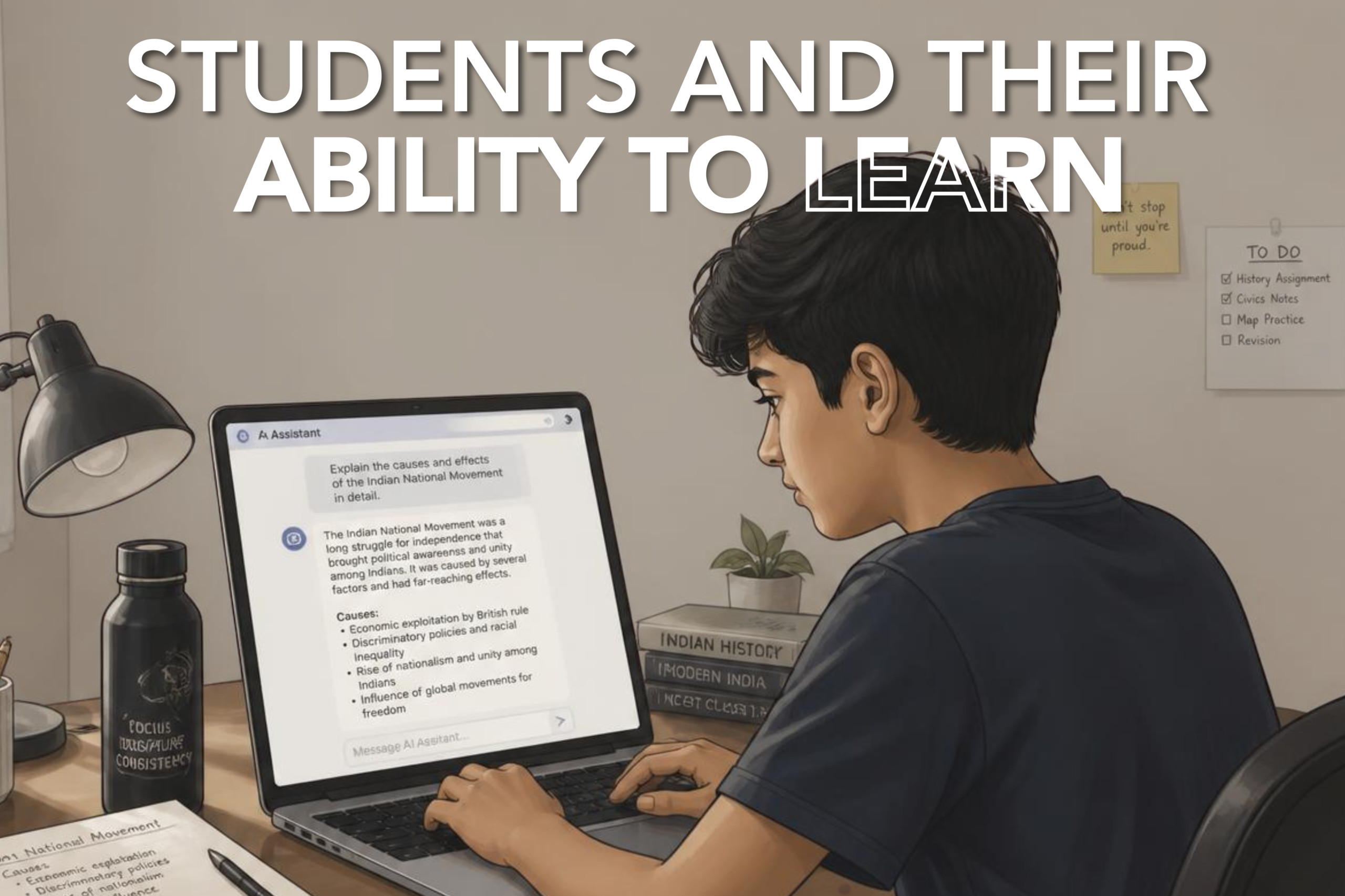
Now the answer to even the toughest question is one search away, so no textbooks at 11:00 PM and no friend to rescue.
A full essay can show up as soon as you press enter.
Which brings up a question worth actually discussing, that the great evolution in the process of learning is of any benefit to us?
Are assignments now meant to be done like this?
Or are we still learning something by relying completely on a source.
This isn’t a “don’t use AI” lecture . Nobody needs another one of those.
It’s more about noticing something that’s quietly changing in classrooms and group chats and 11 pm homework sessions everywhere.
It’s about whether independent learning is slowly becoming a rare skill instead of a normal one.
Why Doing Your Own Assignments Still Matters
Doing your own work was never really about following the rules or not getting caught.
It was always about what’s happening in your head when you’re stuck, and that stuck wasn’t meant to annoy you but that was the actual point where you learned.
Think about the last time you actually solved something hard on your own.
No help, no shortcuts, no AI, just you and the problem.
Maybe it was a math question, or a messy paragraph you had to rewrite four times, or figuring out the right way to word an awkward message to a friend.
That small “wait, I actually did that” feeling doesn’t come from copying an answer someone else gave you.
It comes from being confused for a while and then not being confused anymore.
That struggle is the main thing that teaches us.
Following are some things that you develop when you actually try and tackle something on your own:-
- you start trusting your own reasoning instead of needing someone else to confirm it
- getting something wrong the first time usually makes it stick better the second time
- you actually get better at finding and using information, which matters way beyond school
- you understand why something works instead of just memorising what the answer was
- you build confidence in your own brain, the kind that shows up when nobody’s around to help you
None of that happens by accident, and none of it happens in one night.
It builds up slowly.
Skipping it might save you twenty minutes right now.
But it also skips the part where you actually become a stronger student.
What Students Lose When Everything Becomes a Shortcut
Every shortcut costs something, even when it doesn’t feel like it in the moment.
When answers come too easily, too often, certain skills just don’t get the practice they need to grow.
Using AI isnt bad because after all its invented to make human life efficient, but at the same time it’s not meant to compromise the learning process.
Apart from replacing the learning methods its also a great threat to environment, to learn more about this visit: https://www.lse.ac.uk/granthaminstitute/explainers/what-direct-risks-does-ai-pose-to-the-climate-and-environment/
A few things that are quietly at risk here:
- critical thinking, basically your ability to question things instead of accepting the first answer you see
- problem-solving, or knowing how to break a confusing question into smaller pieces
- creativity, which usually shows up after you’ve struggled with a blank page for a bit, not before
- memory, since information sticks a lot better when your brain had to actually work for it
- confidence in tackling hard stuff alone, without needing a tool to hold your hand through it
The AI Problem: When Convenience Replaces Learning
AI isn’t the villain in this story.
It’s genuinely useful, and honestly kind of impressive what it can do in a few seconds, But it has always been a human tendency to overuse something that makes their own life convenient.
In the process of thinking about our convenience we forget about our future, present and past.
Evolving is necessary but at the same time looking back at the ways that were adopted to carry out something were planned in such a way that they actually give an output.
For example, assignments are designed to enhance problem solving skills among students, but AI has made it so efficient that it can write much better than humans in no time.
It’s efficient, reliable and easy but it’s not taking you anywhere.
People might argue saying that AI is good, it’s making our life easy, no doubt it is but at the same time it’s compromising our creativity, problem solving skills and harming the environment.
The problem was never that it exists. The problem is how easy it makes it to skip the one part of learning that actually teaches you anything.
How to Become a Better Student Without Relying on AI
Here’s the thing that you need to understand, that relying on AI is not making you a better student, it’s just switching off your brain.
I am not saying that don’t use it completely, use it but smartly that it doesn’t compromise with your learning process.
Some things worth actually trying:
- look things up in books, journals, or credible websites instead of grabbing the first answer that pops up
- ask a professor or a classmate before searching online, since talking it through out loud usually helps more than reading ever does
- take notes in your own words instead of copying someone else’s exact phrasing
- break a hard assignment into smaller, dumber questions instead of staring at the whole thing at once
- try recalling stuff from memory before you check, even if you get it wrong
- give yourself a few extra uncomfortable minutes with a problem before searching for the answer
These aren’t just homework tips but something that we actually enhance your memory and skills.
The Last Line
Struggling with an assignment doesn’t mean something’s wrong with you.
Most of the time it just means you’re right in the middle of learning something you didn’t know before.
That in-between feeling, confused but still trying anyway, is uncomfortable. It’s not a sign you’re failing at it.
Getting something wrong isn’t proof you’re bad at it. It’s proof you actually tried.
Every messy draft, every wrong answer, every half-finished attempt at 11 pm is part of how understanding actually gets built.
The point was never to finish every assignment as fast as humanly possible. It was always to walk away knowing something you didn’t know an hour ago.
If any of this feels familiar, whether it’s the confidence part, the independent thinking part, or just wanting to sit with hard problems without spiraling, the conversations happening in Niqay’s student community talk about exactly this stuff, honestly and without the lecture.